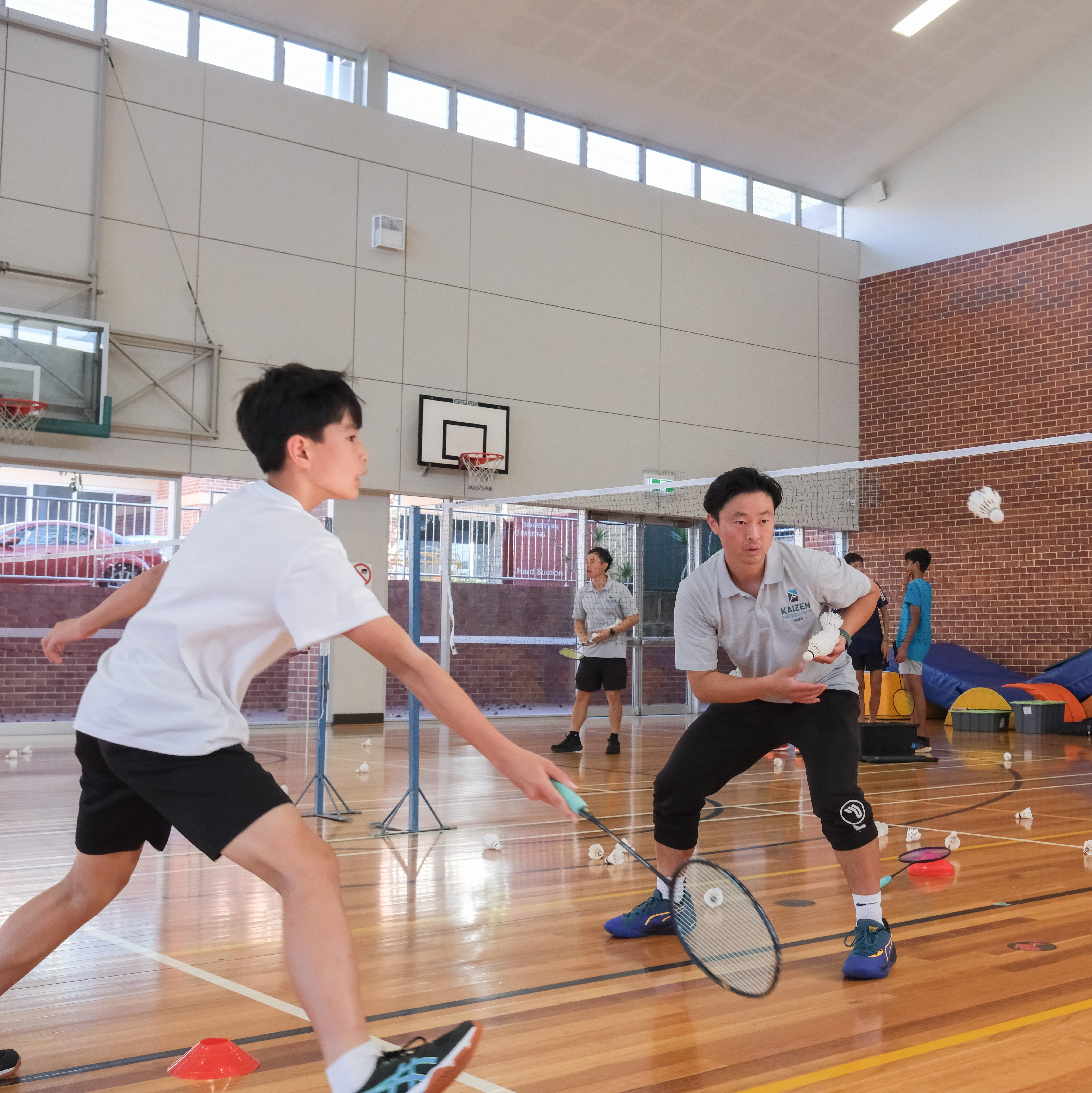


Daniel Fan is the Head Coach at Kaizen Racket Club, working with junior, senior, and representative athletes. His coaching focus centres on long-term development, strong foundations, and helping athletes learn how to improve independently.
Daniel began badminton later than many of his peers who aspired to compete at a high level. That late start, combined with his non-traditional pathway through the sport, continues to shape his perspective and approach to coaching today. He completed his Bachelor degree as an Exercise Sport and Rehabilitation Scientist in 2024, further strengthening his evidence-based approach to athlete development.
Qualifications:
- Bachelor of Exercise and Rehabilitation Science.
- Badminton Australia Foundation Coach.
Coaching Experience:
- Badminton Australia National Selector 2026-Present
- Wesley College Director of Badminton 2023-Present
- Badminton WA Board member 2025
- Badminton WA U13 State team Coach 2025
- Badminton WA U17 State team Manager 2022, 2023
- Assistant Head Coach at Christ Church Grammar School 2021, 2022
- Badminton WA Wings coach 2020
- Head Badminton Coach at Aquinas College 2014-2020


Daniel competed internationally, representing Australia at several major events. These included the World University Games (2017), the Indonesia Open (2019), the Australia Open (2019), the Korea Open (2019), and the World Championships (2019).
He was an active competitive player from 2008 to 2020, representing multiple state teams throughout his career.
During the Tokyo 2020 Olympic qualification period, Daniel was the highest internationally ranked Australian for much of the campaign and led the national standings. Despite carrying a significant injury for most of this period, he continued competing at the top level before eventually retiring from professional badminton in 2020.


Daniel was a late starter and was never considered a standout junior athlete. While he represented state teams, he was rarely the most prominent player within them. Progress was gradual, and shortcuts were never available.
He first picked up badminton at the age of 12, relatively late for those aiming to compete seriously. Prior to that, he participated in a wide range of sports including AFL, soccer, golf, and cricket. Badminton was one of the last sports he was introduced to, but it resonated strongly with him. As an individual sport, it placed responsibility squarely on personal development, something he found both motivating and empowering.
Training and developing in Perth meant limited access to international exposure, resources, and high-performance environments. There was no system carrying him forward. Improvement relied heavily on self-discipline, self-reflection, and a commitment to making small gains every day.
After high school, Daniel gradually found his footing, establishing himself on the national and Oceania stage and eventually competing internationally. During this time, he balanced life as a part-time student, part-time athlete, part-time worker, while still maintaining a social life. The experience reinforced an enduring lesson: development is rarely linear, and consistency matters far more than early success.
Daniel was fortunate to be coached by Zhang Ai Ling, a three-time world champion, alongside her family, Chen Chenjie, and mentored by their son Tiger Chen. Significant time was spent developing strong technical and movement foundations. What was not fully understood at the time later proved critical. Those foundations became the platform that allowed Daniel to compete at the highest level.
A defining moment in Daniel’s career occurred at the 2017 Oceania Individual Championships, where he upset the former Australian number one. At just 22 years of age, he was relatively unknown at the time.
The match went to three sets and lasted one hour and forty-five minutes in close to ninety percent humidity. Daniel was trailing 17–19 in the deciding set before fighting back to win 21–19.
The match became one of the hardest and most memorable of his career. It reinforced a belief that had guided him for years but had never been fully proven. Discipline, belief, and resilience can close gaps that talent alone cannot. In that moment, years of incremental improvement and persistence were validated.

Because Daniel was never a standout junior, he coaches with empathy for athletes who may not peak early.
He understands the experience of working hard without immediate results and believes that consistency, intention, and environment matter more than labels or early success. This belief sits at the core of Kaizen.
Kaizen is not simply a philosophy Daniel teaches. It reflects how he developed as an athlete and continues to guide how he coaches, leads, and supports others on their journeys.
Daniel coaches because he understands how uncertain and isolating the development process can feel when progress is slow or unclear.
Badminton is an exceptionally demanding sport, where improvement is rarely obvious and results do not always reflect the work being invested. Coaching allows Daniel to guide athletes through that uncertainty, helping them stay grounded and recognise that progress often occurs beneath the surface long before it becomes visible.
What keeps him invested is watching athletes develop ownership of their journey. Not just becoming better players, but more self-aware, resilient, and accountable individuals.
There is also a strong sense of responsibility and pride in having reached the world stage from Australia, a country not traditionally known for badminton, and from Perth, one of the most geographically isolated capital cities in the world. Daniel did not begin his journey at the front of the pack, yet progressed all the way to international competition. The lessons learned along that path now form the philosophies he feels compelled to champion and pass on to those within his coaching circle. Coaching, for Daniel, is deeply satisfying and purposeful.
Daniel does not believe in a single coaching style that works for everyone.
His teaching and feedback are adapted to the individual athlete. Some respond best to clear structure and repetition, while others benefit more from guided problem solving. His aim is not simply to correct technique, but to ensure athletes understand why changes matter and how to apply them independently in both training and competition.
Daniel believes effective coaching develops thinkers, not just performers. He was particularly influenced by coaches who led by example, were relatable, and represented standards he aspired to meet or surpass.
Every athlete learns differently, and Daniel places strong emphasis on open-mindedness and understanding situations from the athlete’s perspective.
He values listening to athletes and coaches from other sportingF different sporting backgrounds, as it helps break out of the “badminton bubble” and encourages a more holistic approach to coaching. He regularly draws on past experiences, both positive and challenging, to problem-solve in real time.
Adaptability is essential. Sessions evolve, communication shifts, and feedback must change as athletes grow. Effective coaching requires the ability to adjust on the fly while still maintaining long-term objectives.
Daniel believes effective development comes from balancing guidance and independence.
Excessive instruction can limit ownership, while too much freedom too early can disrupt learning. Clear communication helps athletes understand not only what to do, but why it matters. Patience is equally important, as progress is rarely linear.
When the balance is right, it creates an environment that supports sustainable, long-term growth.
Daniel has shared his journey and coaching philosophy through in-depth conversations on The Badminton Podcast, discussing the realities of high-performance sport and long-term development.
In Coaching Is Not About You, he explores athlete-centred coaching, responsibility, and why effective coaching extends beyond technical instruction.
In The Pain of an Olympic Journey, he discusses the emotional, physical, and mental challenges of pursuing elite sport, including setbacks, resilience, and long-term commitment.
You can also watch Daniel’s personal video documenting his journey towards the Tokyo 2020 Olympic Games here:
https://www.youtube.com/watch?v=OF_k-lMEt9E&t=10s
Watch highlights from Daniel’s match against a former world No. 1, alongside his personal reflections on what the experience meant to him:
https://www.facebook.com/BOC.badminton/videos/600566147117815
https://www.facebook.com/BOC.badminton/videos/507295400025224
